The Town Can't Stop Your Maggie Valley Short-Term Rental. Your HOA Still Can.
August 20, 2026
August 20, 2026
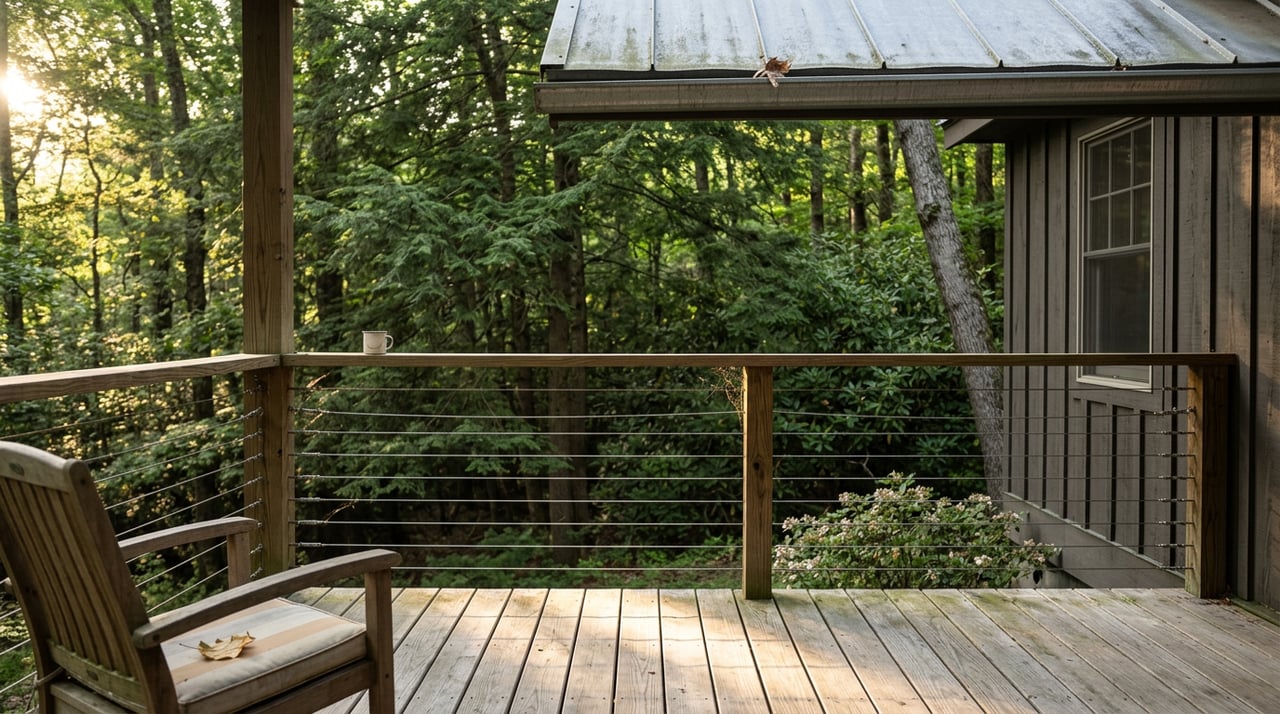
Picture the sequence that plays out every summer in Haywood County. A buyer closes on a cabin off Soco Road, checks the town's zoning map to confirm short-term rentals are allowed, reads that North Carolina law keeps Maggie Valley from requiring a rental permit, and lists the property on Airbnb the following week. Then a letter arrives from a homeowners association nobody mentioned twice during the walkthrough, informing the new owner that the recorded covenants on the property cap rentals at 30 days or longer. The town never had the authority to stop this. The HOA never needed it.
That gap between what the town permits and what a private document allows is the single most consequential thing a Maggie Valley short-term rental buyer can misunderstand. Everything else, the tax registration, the pending rate change, the swirl of conflicting listing-count data, sits downstream of it.
Maggie Valley's regulatory posture toward short-term rentals is genuinely permissive, and buyers are right to notice that. The town's Unified Development Ordinance carved out twelve zoning districts, one of them built specifically for this use: R4, Seasonal and Short-Term Residential, a category that exists to accommodate cabins, cottages, and vacation communities as a matter of right rather than as a conditional or special exception. Layered on top of that, North Carolina state law prevents municipalities from requiring a rental permit or registering short-term rentals as a condition of operating them, and from banning the use outright. Together, those two facts mean the Town of Maggie Valley cannot show up and shut down a listing simply because it's a listing.
That's a real, structural advantage over towns like Asheville, where whole-dwelling rentals are restricted to a narrow resort zoning district, or Wilmington, where a court had to strike down a city-run rental registry before owners got clarity. Maggie Valley buyers don't inherit that fight. But the town's hands-off posture is often mistaken for the whole picture, and it isn't.
State law constrains what a municipal government can do. It says nothing about what a homeowners association can put in its recorded Declaration of Covenants, Conditions, and Restrictions. Under North Carolina's Planned Community Act, an HOA can prohibit short-term rentals entirely, cap the number of rental nights, or require minimum lease terms, and none of that runs into the same preemption problem that stops the town. If anything, the legal odds favor the HOA. A restriction written into the original Declaration when a subdivision was first platted is much harder to challenge than one adopted later, because every subsequent buyer is treated as having bought the property with that restriction already in place and already known.
A covenant that predates your purchase isn't a rule you can negotiate around at closing. It's a term you already agreed to the moment you took title.
This is why a buyer's due diligence in Maggie Valley has to include two separate questions that don't answer each other: is the zoning right, and does the recorded Declaration for this specific subdivision say anything about rentals. Many mountain HOAs in the region are genuinely light-touch, focused on road maintenance and architectural standards rather than rental restrictions. Others were written decades ago by developers who wanted a quiet residential feel and never anticipated Airbnb. You cannot infer which kind you're buying into from the presence of an HOA sign at the entrance. You have to pull the recorded document.
| What controls it | Who enforces it | Can it stop your rental? |
|---|---|---|
| Town zoning (R4 district) | Town of Maggie Valley | No, if the property is zoned R4 or otherwise compatible with residential use |
| State preemption law | State of North Carolina | Prevents the town from requiring a permit or banning STRs outright |
| Recorded HOA Declaration | The homeowners association | Yes, if the covenants prohibit or cap short-term rentals |
| Haywood County occupancy tax registration | Haywood County Finance Office | Doesn't stop the rental, but non-compliance carries financial penalties |
Even a property with clean zoning and a rental-friendly HOA still owes the county paperwork that has nothing to do with permission and everything to do with tax collection. Anyone renting a Maggie Valley property for stays under 90 days has to register with the Haywood County Finance Office using the Lodging and Occupancy Tax Form, then file a monthly remittance, even in months with zero bookings, by the 20th of the following month. Skip it and the penalties compound: a 10 percent late-payment penalty, an additional 5 percent for each month the return goes unfiled, capped at 25 percent, and in cases the county deems willful, the exposure moves from a civil penalty into misdemeanor territory.
This isn't a rental permit in disguise. State law that keeps towns from requiring rental registration doesn't touch a county's separate authority to collect an occupancy tax, which currently sits at 4 percent in Haywood County on top of state and local sales tax. It's a tax filing obligation that exists independent of whether your zoning is favorable or your HOA is silent on rentals, and it's the piece new owners most often discover only after the first past-due notice.
Haywood County's occupancy tax rate isn't fixed in stone. House Bill 169, introduced in the North Carolina General Assembly's 2025 session, would raise the county's occupancy tax authority from 4 percent to 6 percent, alongside changes to how the Tourism Development Authority's board is structured. As of the most recent legislative tracking available, the bill had been referred to committee rather than enacted, which means the 4 percent rate buyers are underwriting today is not a number they should treat as permanent over a five or ten year hold. Anyone running the numbers on a Maggie Valley purchase should build a version of the model that assumes the higher rate takes effect, and see whether the investment still works.
Here's where the data gets genuinely strange, and where the strangeness is the point. One widely cited short-term rental data platform reports Maggie Valley's active listing count growing 79 percent year over year. Another, pulling from the same booking platforms over the same period, shows active listings down 10 percent for the twelve months ending in June 2026. Those two numbers cannot both describe the same market, and the disagreement matters more than either figure on its own. "Active listing" gets defined differently across platforms, some count anything with a live page regardless of recent bookings, others drop a listing that's gone quiet. A buyer who anchors an investment decision to whichever number showed up first in a search result is trusting a definition they never checked.
The more internally consistent read comes from a single dataset tracked month over month: as of June 2026, Maggie Valley carried 845 active short-term rental listings, with average revenue per listing of about $27,800 over the trailing twelve months, 47 percent occupancy, and an average daily rate of $232. Year over year, that same dataset shows revenue per listing up roughly 9 percent even as occupancy fell 2.2 percent, average daily rate slipped 1.9 percent, and revenue per available night dropped 5.7 percent. Active listings, on this measure, fell 10 percent.
Put plainly: the per-night performance metrics all softened, but the properties still standing collected more money over the year, and there were fewer of them. That's not what a booming rental market looks like. It's what a consolidating one looks like, weaker or non-compliant operators exiting while the properties still active absorb a larger share of demand. A market shedding listings while revenue per remaining listing climbs is consistent with owners who skipped the covenant check or the tax registration eventually getting priced out by fines, HOA enforcement, or the simple math of running a rental that was never supposed to be one. The paperwork isn't a footnote to the investment. For a meaningful share of this market, it appears to be the filter deciding who's still in it.
Does Haywood County require a permit to run a short-term rental in Maggie Valley? No. State law prevents the town from requiring a rental permit or registering the use as a condition of operating. What the county does require is occupancy tax registration, which is a tax filing, not a use permit.
Can a homeowners association in Maggie Valley legally ban short-term rentals even though the town allows them? Yes. HOA covenants operate independently of town zoning. A recorded Declaration that predates your purchase and restricts rentals is generally enforceable against you as the buyer, regardless of what the town's ordinance allows.
What happens if I never register for the Haywood County occupancy tax? Penalties compound monthly. A 10 percent late-payment penalty applies first, with an additional 5 percent added for each additional month a return goes unfiled, up to a 25 percent cap, and cases found to be negligent or willful can carry misdemeanor exposure.
Is the 4 percent occupancy tax rate guaranteed to stay where it is? No. House Bill 169 would raise Haywood County's occupancy tax authority to 6 percent. It had not been enacted as of the most recent legislative tracking, but any income model for a Maggie Valley rental should account for the possibility that the rate changes during the hold.
A property that's legally zoned for short-term rentals and still can't be rented isn't a rare edge case in this market. It's a predictable outcome for anyone who checked the town's rules and stopped there. If you're evaluating a specific Maggie Valley property for its rental potential, Catherine Proben can help you work through the covenant, zoning, and tax pieces together before you write an offer, not after you're already the one holding the letter from the HOA.
Stay up to date on the latest real estate trends.


Experience a real estate partnership built on trust, expertise, and genuine care. Catherine brings a lifelong understanding of what “home” truly means, guiding you through every step of your real estate journey with personalized service and dedication.
Get In Touch With Our Team To Learn More
CATHERINE PROBEN
ADDRESS 74 N Main St Waynesville, NC 28786